


Spirituality
[vc_row css_animation=”” row_type=”row” use_row_as_full_screen_section=”no” type=”full_width” angled_section=”no” text_align=”left” background_image_as_pattern=”without_pattern”][vc_column][vc_column_text]<– Return[/vc_column_text][/vc_column][/vc_row][vc_row css_animation=”” row_type=”row” use_row_as_full_screen_section=”no” type=”full_width” angled_section=”no” text_align=”left” background_image_as_pattern=”without_pattern”][vc_column width=”2/3″]
A teacher I respect recently said he realized the innate nature of reality is “nothingness.” How can I feel positive and optimistic about reality, death, what we are, and where we will return to in light of this?
I’ve walked through how I consider it in Neurodharma, especially chapter 9 on Finding Timelessness. I encourage you to read it if you haven’t already.
A lot of meditation teachers who are atheist or agnostic may still have a super deep realization and practice. Personally, I have the experience and view that the ground of all – in the natural, Big Bang universe – is a single sort of field in which everything is interdependent and empty of absolute self-existence. Just resting in the sense of this (natural) ground is a beautiful thing, and along with the ending of craving (and greed and hatred) is the aim at a minimum of Buddhist practice.
Additionally, I have the experience and view that there is a (transcendental) Ground to the ground of all that is mysteriously conscious and benign. This would be a way of describing God for some people. This way of looking at things is shared with many people.
I’m OK with teachers who refer to reality as “nothingness.” Maybe they’re right. What they say is still good news and a wonderful path of practice. But, what the heck, I happily believe that there is more to it! And what they say does not undermine my own experience and view of the capital-G Ground.[/vc_column_text]
What the definition of Vipassana meditation?
Vipassana is aided by shamatha, the development of steadiness of mind, including through Right Concentration and the jhanas. The two support each other.
There is more there about all this in the Steadying the Mind chapter of Neurodharma?[/vc_column_text]
Can anyone develop a “buddha brain” — even people struggling with mental illness or depression?
First, a “buddha brain” is simply one that knows how to be truly happy in the face of life’s inescapable ups and downs. (I don’t capitalize the word “buddha” here to focus on the original nature of the word – which is “to know, to see clearly” – to distinguish my general meaning from the specific historical individual known as The Buddha.) The possibility of this kind of brain is inherent in the human brain that we all share; any human brain can become a buddha brain. Therefore, a buddha brain is for everyone, whatever their religious orientation (including none at all).
Second, we all must begin the path wherever we are – whether that’s everyday stress and frustration, mental illness, anxiety, sorrow and loss, or depression. In any moment when we step back from our experience and hold it in mindful awareness, or when we begin to let go of negative feelings and factors, or when we gradually turn toward and cultivate positive feelings and factors we are taking a step toward developing a buddha brain. Each small step matters. It was usually lots of small steps that took a person to a bad place, and it will be lots of small steps that take him or her to a better one.
Third, mental anguish or dysfunction can help us grow. They teach us a lot about how the mind works, they can deepen compassion for the troubles and sorrows of others, and, frankly, they can be very motivating.
Personally, the times in my life when I have been most intent on taking my own steps toward a buddha brain have been either when I was really feeling blue – and needed to figure out how to get out of the hole I was in – or when I was feeling really good, and could still sense that there had to be more to life than this, and more profound possibilities for awakening.[/vc_column_text]
Does taking vows (to not do something) have a stronger effect than simply choosing not to do something each time? Is the anterior cingulate cortex (ACC) activated continuously for the period of vowed restraint? If so, then does the growth of the ACC enhanced compared to an individual who practices restraint only when presented with object of desire?
For all these reasons, the ACC is super and worth training . . . . but long-term I think happier and more sustainable motivation comes from a psychology of giving over to the greater happiness and letting it live us, and from a neurology that emphasizes reward systems in the subcortex.
In terms of the ACC, the whole brain works together to motivate us. In this context, the ACC flags divergences from goals (e.g., vows, choices). So it tends to be involved in top-down “sour” alarms about what we are turning away from rather than bottom-up “sweet” rewards in what we are turning toward. Plus there is “willpower fatigue” when we emphasize top-down forms of motivation.[/vc_column_text]
How is your approach to “awakening” related to the Buddha’s 7 factors of awakening?
In the last sense they are “factors” of awakening, but I tend to avoid that term in order to:
- avoid confusion with the Buddha’s “7 factors of awakening” (i.e., mindfulness, investigation, energy, bliss (rapture, joy), tranquility, concentration, equanimity) – which of course I respect profoundly
- emphasize the sense of being already what one aspires to be; the sense of dropping into a steadiness, nowness, etc. that is already true, already the case
[/vc_column_text]
Is gratitude beneficial as a spiritual and/or mindfulness practice in and of itself?
Of course, each of these benefits also gently and gradually shapes one’s own brain in an increasingly positive direction.[/vc_column_text]
Does Buddhism condemn suicide? Is depression viewed as a weakness in the mind that can be cured through vipassana?
About suicide: I am not aware of any quote from the Buddha himself on the subject. It is clear, though, in the Buddhist meta-model, that we always inherit the results of our actions, for better or worse – in this life, mainly, and in other ones, too. My personal opinion is that killing oneself out of kindness (e.g., euthanasia at the end of life in terminal, hopeless, excruciating pain) is one thing, but killing oneself because of inherently transient conditions such as depression is profoundly unkind to the one person in the universe we have the highest duty to, the one we have the most power over: your future self.
Keep going! Don’t give up. You are an excellent person, and will certainly inherit the good results of your good intentions, good actions, and good heart.[/vc_column_text]
How can someone deal with cruelty, in their mind? How can one stop the mind from ruminating on horrible images of violence, without going back into denial?
Second, in a sense you are speaking about trauma in general and how to clear it from the mind. This is a big topic, and I’ll just say here a few things that might help:
- When the painful imagery or related thoughts arise, willfully shift attention elsewhere, especially to things that are stimulating and engage attentions, such as jumping up and down, eating something good, or giving/receiving love.
- Focus on the emotions and sensations of compassion, drawing awareness away from imagery or inner speech.
- Remind oneself what one is doing to help things get better; engage attention to this in rich ways such as reviewing actions or interactions and feeling what’s good about them (not just having an idea that one has sent money to a worthy cause).
- Have confidence that over time painful imagery does tend to fade or at least not preoccupy one, though it can still get triggered.
- If it helps, try EMDR or related trauma therapies.
- You might be able to get value from the Buddhist teaching about the emptiness of all experiences, no matter how wonderful or awful.
Experiences exist in some sense, but they are transient, insubstantial, made of parts, and arise due to causes, and therefore they are “empty” of absolute self-existence. In a sense, they are like clouds, not bricks.[/vc_column_text]
What role does following any faith practice play in calming the mind, body and soul?
Do you think any of the material properties of the universe could provide the basis of a larger consciousness?
Slightly longer: My personal view is that ordinary awareness – the awareness of cats, dogs, monkeys, whales, and humans (and probably that of lizards, worms, and fruit flies) – is likely fully explainable by the operations of the nervous system, embedded in the body, nature, and in “higher” animals, including us, by culture. I think we are a century or two from this full explanation – it’s that complex and subtle a topic – but that such an explanation of ordinary awareness entirely in terms of the natural frame will eventually be developed.
And – my personal view is also that material reality includes, entails, requires, and depends upon some sort of currently mysterious consciousness, woven into the fabric of reality itself. For quantum potentiality to emerge into quantum actuality at the emerging edge of now – always and eternally – I think there must be some kind of consciousness . . . a kind of consciousness that we can barely if at all imagine . . . another word for which is God.
These two views of mine make me deeply grateful for the gifts of evolution and life, in terms of my ordinary awareness, and make me deeply awestruck and humbled by the prospect of and by the sense of each emerging moment of my life and the universe altogether being a passing manifestation of the underlying Divine nature of this other person, this breath, this experience, this word.[/vc_column_text]
What does it mean to be enlightened – does it mean being free of suffering?
In early Buddhism, enlightenment is conceived of in four stages, starting with stream entry and ending as an arahant. I like the way enlightenment is operationalized for an arahant: irrevocably (which gets to your query about losing enlightenment), greed, hatred, and delusion (broadly defined) no longer arise in the mind at all, or perhaps arise subtly and occasionally but can find no hold. That’s a psychologically meaningful definition I can relate to.
In effect, we are already enlightened (in the sense of always already having Buddhanature; it’s just obscured by the usual crud) and we have moments of awakening that inspire and purify us. . Over time and with practice, those jewel-like moments become deeper, longer, and more stable, gradually stitching together at the highest levels into a seamless necklace of unconditional love and inner peace. Pretty good news![/vc_column_text]
Is there an objective reality?
The Buddha never denied materiality, nor Nagarjuna. What’s happening may be empty in the technical sense, but it is still existent. The existence of karma (in this life for sure, and maybe across lifetimes) is central to Buddhadharma, for example. Our descriptions of reality are inherently limited – but so what? The pictures on the menu may not match the meal, but the hamburger still tastes pretty good. It may be a useful practice to regard experience as like a dream – but that is not the same as the ontological stance that immaterial experience and its material neural/biological underpinnings do not exist, which is an absurd and in my view ultimately arrogant position. Materiality was here long before humans, nervous systems, or life altogether.
The wonderfully freeing truth is that life happens. Things happen for 10,000 reasons, most of which have nothing to do with us. Yes we do produce causes, especially through our intentions, but we are also an effect of many other causes. Even if some causes travel across lifetimes, they are not the whole set of what’s determinative in any single life.
All content is empty and impermanent. Place your faith in what endures, in what is still amidst the changes: the nature of things, the unconditioned, the consciousness and love that is inherently entwined in the emergent edge of everything for it to be at all.[/vc_column_text]
What are the unique contributions of being religious to happiness?
While the average religious person may be happier than the average non-religious person, that’s just about averages. Lots of religious people are unhappy, and lots of non-religious people are happy.
There is tons of science about how all people, religious or not, can affect their happiness. Basically, we can become happier by taking action in the world (e.g., doing crafts with your hands, giving to charity, planting a tree, getting a less stressful job, finding a loving partner), the body (e.g., losing weight, getting exercise, healing an illness, getting enough iron), or the mind.
While I can speak with authority on ways to boost happiness through action in the world or body, my expertise is the mind. In the mind, major factors that increase happiness include controlling negative emotions, controlling stress, savoring positive experiences (which defeats the negativity bias of the brain that makes it like Velcro for negative experiences but Teflon for positive ones), focusing on what one can do (how you’re like a hammer instead of a nail), positive self-talk instead of anxious or self-critical rumination, developing interpersonal skills that produce healthier relationships, gratitude, feeling connected with others, and feeling a sense of purpose and meaning in life.
Because of experience-dependent neuroplasticity – a mouthful that simply means that what we think and feel and want changes our brains – the mental factors and activities just above gradually build up strengths in the brain, much like building a muscle. The classic saying in brain science is: neurons that fire together, wire together.
The last three factors just above – gratitude, feeling connected to others, and purpose and meaning – are strong in most religious people, though of course they don’t have a monopoly on them. Your question hits the bullseye: what are the unique contributions of being religious to happiness?
A way to frame this could be, what can non-religious people learn from religious people about happiness? With a point made about how this learning can change the brain for the better.
Religious practice often involves a specific mental activity – focused attention on prayer or meditation: in other words, some kind of contemplative practice – that has good research on how it changes the brain. For example, Christian nuns recalling a profound spiritual experience and thus momentarily lighting up parts of their brains that control attention, tune into oneself, and feel rewarded. Or how the brains of long-time mindfulness meditators are changed in lasting ways, also building up layers of neural tissue in parts of the brain that control attention and tune into oneself. Non-religious people could also take up some kind of contemplative practice, even if they don’t think of it as religious or spiritual, such as meditation on the breath or really focusing on the body while doing Pilates, etc.
There is a lot of research coming out about the benefits of mindfulness training – outside a religious context – for controlling attention, improving response to medical treatment, and increasing happiness.
As a religious person myself – a Buddhist who believes in the Divine – I think there are certain aspects of religious life that you have to be, er, religious to benefit from, such as a sense of a personal relationship with God (by whatever name). I don’t know of any specific studies on this unique factor – though there may be some – but I can speak personally about it and report what others say, which is that it brings a sense of peace and joy.[/vc_column_text]
In your opinion, does God exist?
I think there either is God or there isn’t. If there is, that seems quite extraordinary and important to me, in my value systems, so it is a priority for me to discern the divine if it in fact exists. As to how I pursue that discernment, it is through both reason and experience.
Reason suggests to me:
- There are enormous limits to both naturalistic evidence and human reason itself. Just 10 years ago, we were ignorant of 95% of the universe. Who knows what people will have learned a thousand or a million years from now. There is so much we do not know, and there may be so much we can never know. For me it is appropriately modest – and consistent with the culture of science – to not make strong assertions about many things, including the nature of the universe and whether God exists.
- It is scientifically plausible for some kind of consciousness to be necessarily woven into the nature of physical reality in order for quantum potentiality to congeal into actuality at the leading edge of now. This consciousness is another name for God.
- Many profoundly wise people throughout history have asserted the existence of God and their union with it, and factually the experience of others around these people is that there is something truly extraordinary coming through them. (I am not interpreting these facts as naturalistic proof for God’s existence, but rather as eyebrow-raisers, as a kind of “hmmmmm.”)
- There are many examples of people knowing things that seem utterly inexplicable within the frame of science. Throw out 99% of these examples as explainable naturalistically, and that still leaves 1% – and for an existence proof, it takes only one.
Experience intimates to me a personal sense of something benevolent, conscious, sacred, and profound that is beyond my reason.[/vc_column_text]
Can MBSR really be labeled as mindfulness meditation if it only relies on the sustained present moment awareness and not without the old theories of awareness?
When taken by itself, there is considerable research evidence for the benefits of MBSR in particular and of related secular trainings in mindfulness (defined as sustained present moment awareness, typically combined with qualities of self-acceptance and curiosity). This research is credible and a sound basis for applications in the settings you work in. So, from a secular perspective, things seem clear. MBSR is not Buddhist any more than self-awareness, attention training, self-acceptance, or meta-cognition are Buddhist. If someone says, “We can’t teach mindfulness since that is Buddhist,” I politely tell them that this is mistaken: the Buddha in particular and Buddhism in general has no monopoly on mindfulness, compassion, taking personal responsibility, insight, or kindness even though these are central elements of Buddhism.
But, from a Buddhist perspective, some people (such as Jon Kabat-Zinn and other respected teachers) think it is fine to extract elements of Buddhist practice (e.g., mindfulness) and then apply them outside of that Buddhist context, while other respected teachers think that this is wrong to do. Myself, I side with Jon on this question.[/vc_column_text]
I’m very interested in your work, but you reference evolution quite a bit, and I am a Christian and do not believe in evolution.
My dad also worked in the fish and game departments of several states and eventually became a zoologist and a professor at Cal State LA. Throughout his scientific career he remained a Christian. He had great curiosity and wonder and gratitude for the vast universe that God had created. He was very aware of the long sweep of time, and amazed and thankful about being able to be alive during this remarkable period in our world’s history.
In all this, two things remained very true for him: his faith in God, and his humble respect for facts: the breeding of different kinds of dogs over time, how long it took to carve the Grand Canyon, the vast diversity in Nature, how DNA works, the extremely careful dating of the geological layers of the earth and the fossil records within them, and the enormous body of evidence for the very slow and gradual shaping of life on our planet over several billion years. In all this, my dad’s faith never wavered. For him, the development of beautiful birds and plants and people and other living things was a sign of God’s grace. And he drew upon what he knew about how life had been shaped over time at the level of organs, cells, and even molecules to be skillful in his work, effective in advocating for his medical care, and at peace in his final days.
I, too, have faith in and a sense of God. And in understanding any physical system such as the brain, it can be useful to consider it in terms of how it was developed over time. If that frame of reference is not helpful to you, truly you can just ignore it and simply do the guided meditations in the audio program. They are the most important part of the program. And you can set aside everything else.
If you’d rather not do this, you might like programs related to what is called Mindfulness-Based Stress Reduction, a simple form of meditation that does not refer to biology and has a great deal of research support. You might also be interested in Christian forms of contemplative practice, such as Centering Prayer; that practice has been meaningful for me personally, as well as reading a short lovely book: The Practice of the Presence of God. There are also excellent books about mindfulness with children, such as Everyday Blessings.[/vc_column_text]
Sometimes you will speak about Buddhism without covering the material of it at all.
In this context, I’d like to offer that the subtitle for my column at Psychology Today – “practical insights into happiness, love, and wisdom from psychology, neuroscience, and Buddhism” – is a general statement about the territory of my writings here. It doesn’t mean that each post will contain explicit references to each one of these: happiness, love, wisdom, psychology, neuroscience, and Buddhism.
Also, while Buddhism has no monopoly on encouraging love, the deliberate cultivation of compassion, lovingkindness, happiness at the welfare of others, generosity, non-harming, wise speech, and other ways to feed the wolf of love are absolutely central to Buddhist practice. My posts, and those of others, may lack an explicit reference to psychology, neuroscience, or Buddhism while still very much drawing upon those deep roots.
Last, as someone who does teach *about* Buddhism, my personal opinion is that it is also OK to draw *from* Buddhism, explicitly or implicitly, without getting into an exposition of the dharma as a whole. Much of the time that exposition would be off-topic or inappropriate given a particular setting; I think this is generally true about blogs on Psychology Today, including my own. As long as one doesn’t represent some explicit or implicit aspect of Buddhism as the whole of the path, then whatever is conveyed – in this case, the benefits of nurturing love, broadly defined – should be judged on its own merits, and not whether it teaches people about Buddhism altogether.[/vc_column_text]
I do not understand how “the fabric of this suffering” is the underlying operating of the mind. If we feel worry, pressure, or pain, how could the underlying operating of the mind be fine?
What I was trying to say is that the contents of mind – anger, worry, pleasure, thoughts, perceptions, sensations, desires, etc. – are a part of the mind that may be troubled (even horribly so), but mind as a whole – including the awareness aspects of mind – is usually operating just fine.
So shifting awareness from the contents of mind to mind itself (as a whole) – put differently, shifting awareness to experience as a whole, including its awareness elements – can disengage us from upsetting thoughts and feelings and ground us in a reassuring sense of mind as a whole.
Try this experientially and see what you find. The sense of mind as a whole can be hard to sustain, but keep at it and it will get more stable. Also note that as soon as we (naturally) create a concept of mind-as-a-whole, that conceptualizing is a part of mind-as-a-whole and draws us out of it as a whole. Conceptualizing is OK, but keep letting go of it to open into again and again mind-as-a-whole.[/vc_column_text]
How to you balance equanimity and cultivation?
With time, the fruits of this process of cultivation become increasingly second nature, woven into the fabric of the brain, the body, and them mind. Then conscious cultivation – Right Effort – gradually falls away and we abide without effort in spacious balanced peaceful beautiful equanimity.[/vc_column_text]
I object to some of the languaging used in your HEAL method, e.g. “positive and negative material, “pulling weeds“, as this seems incompatible to a mindful attitude toward these feelings.
I find that many people who work within the MBSR framework are confused about what mindfulness actually is, and think it is only equivalent to choiceless witnessing of the stream of consciousness. That is a wonderful stance to take sometimes with the mind, especially in meditation – the epitome of letting be –- but it is not the ONLY way to practice! And it is not the only way to be mindful.
In terms of practice, as the Buddha and others have taught, we also need to make wise efforts with the mind, essentially consisting of letting go and letting in. For example, pretty much all of the elements in the Noble Eightfold Path – from a major fan of mindfulness, the Buddha himself – involve either letting go or letting in. In terms of mindfulness, we should be mindful while being standing up to injustice, releasing and uprooting unwholesome tendencies in ourselves, and cultivating inner strengths like compassion, happiness, resilience, and mindfulness itself.
To practice and to live, we need to make distinctions and have values. There is no way around this. To avoid making distinctions requires making a distinction, and to avoid values is itself a value. So we use language to label these distinctions and values. I have no problem with saying that feeding children is “positive” and “better” compared to leaving them hungry which is “negative” and “worse.” Nor a problem with aiming to release craving and clinging and ill will and addiction and trauma . . . and describing these kinds of letting go with the metaphor of “pulling weeds.”
We can have a wide open mindful awareness of both the inner and outer world . . . while accepting things as they are . . . while recognizing the limitations of language and other labels . . . and while also recognizing what would be more skillful and helpful and making efforts to manifest that.
Stepping back, what is particularly curious is the righteous dogmatism one sometimes encounters from MBSR or non-dual people – about the horrors of words like “positive” and “negative”, and the terrible pitfalls in actually making deliberate intentional efforts inside one’s own mind. It’s frankly weird, and a problem that mindfulness has become mistakenly reduced to only a passive and inert relationship with the world and the mind, so that anything other than this passivity is claimed to be “not mindful.” For perspective, this is definitely not what the Buddha taught.[/vc_column_text]
What do you mean by the “undoing of suffering?”
Is the “self” real?
- Unification – There’s just one “I”.
- Permanence – The “I” stays the same, things happen to it but it doesn’t change.
- Independence – The “I” is just there, an innate part of the psyche, not created by anything, and fundamentally not dependent on anything (other than a brain) for its existence.
The fact is that these three attributes that constitute an “I” – unification, permanence, and independence – cannot be found in one’s own experience, nor in the neural processes that underlie I-related activations or representations in the brain. The actual experience of “I” is made up of parts (not unified), continually changing (not enduring), and affected by many factors (not independent). This has been seen in neuroimaging studies.
To use the language of Buddhism, the apparent “I” is empty: without substantial, essential nature. Both phenomenologically and ontologically, the presumed “me, myself, and I” is empty. If you like, check out my book, Buddha’s Brain, whose last chapter is about this subject.
In general I think that we can have and value all sorts of experiences of witnessing, integration, beingness, spacious awareness, etc. – experiences of the “self” – while also recognizing that these experiences (and their dynamic neural substrates) are compounded, transient, and dependently arising . . . and thus empty of essence.
Like many others, I’m leery of reifying or substantiating dynamic and insubstantial processes – even vital ones, such as the executive functions, subjectivity (ipseity), or the encompassing awareness that remains when the “parts” step back – into an entity, a being, a self. Trouble and suffering begins when we identify with and try to protect and glorify such an entity.[/vc_column_text]
How do I reduce bondage to the self?
I have found personally that if I treat myself well – as well as I would treat a good friend – then cravings actually decrease, and my addictive tendencies are more manageable.[/vc_column_text]
Could you give some more detail about your background in Buddhist learning and teaching?
Do you have any opinion about metaphysical phenomena?
That said, since you asked, my personal opinion is that there is much evidence that certain things exist that are not yet explained by science as natural phenomena or perhaps not even explainable at all since they exist outside of the natural frame (i.e., they are supernatural or transcendental).
The tiny orbs of light seen by your tour mates sound like such a thing. Personally, it makes me happy that mysteries remain. And meanwhile, of course, the opportunity for practice and service remains in down-to-earth ways, whatever is also true about these others, wondrous phenomena![/vc_column_text]
Do you agree on every point made by the Buddha? (e.g. rebirth, nirvana, samsara, and karma). They could be interpreted metaphorically but then it wouldn't be Buddhism since without “rebirth” the Four Noble Truths are irrelevant.
As to whether there is the supernatural process of reincarnation, I am not sure but think it could be true in the general sense described in the Canon.
This said, I do not believe that reincarnation is a necessary condition for caring about cause and effect – karma – during the period of a single human life. Clearly, without reference to reincarnation, one can see suffering as it is, one can see that craving in its subtle and gross forms causes much suffering, one can see that as craving diminishes so does suffering, and one can see that wise effort, speech, concentration, and other elements of the Eightfold Path reduce craving and suffering. Whether or not there is actually reincarnation, I observe and experience that the Four Noble Truths are profoundly relevant for my own life and that of others.
I offer all this with respect, as my personal opinion and practice. Others may have different views![/vc_column_text]
Additional Resources
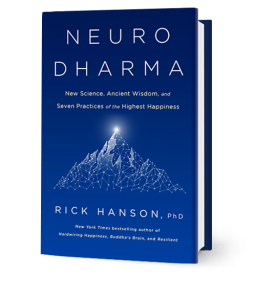
Neurodharma by Rick Hanson, Ph.D.[/vc_column_text][vc_separator type=”normal”][vc_column_text]
Neurodharma online program[/vc_column_text][vc_separator type=”normal”][vc_column_text]
Wednesday Meditation online[/vc_column_text][vc_separator type=”normal”][vc_column_text]
Archive of Wednesday Meditations + Talks on Spirituality
[/vc_column_text][vc_separator type=”normal”][vc_column_text]
Spirituality featured content from Rick Hanson, Ph.D., focusing on spirituality.
[/vc_column_text][vc_separator type=”normal”][vc_column_text]
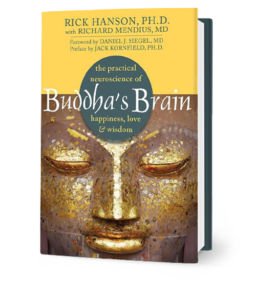
Buddha’s Brain by Rick Hanson, Ph.D.
[/vc_column_text][vc_separator type=”normal”][vc_column_text]
[/vc_column_text][vc_separator type=”normal”][vc_column_text]
Getting on Your Own Side – and the Buddha’s Life Story
[/vc_column_text][vc_separator type=”normal”][vc_column_text]
Developing a “Buddha Brain” Through Gratitude
[/vc_column_text][/vc_column][/vc_row]