


Consciousness
[vc_row css_animation=”” row_type=”row” use_row_as_full_screen_section=”no” type=”full_width” angled_section=”no” text_align=”left” background_image_as_pattern=”without_pattern”][vc_column][vc_column_text]<– Return[/vc_column_text][/vc_column][/vc_row][vc_row css_animation=”” row_type=”row” use_row_as_full_screen_section=”no” type=”full_width” angled_section=”no” text_align=”left” background_image_as_pattern=”without_pattern”][vc_column width=”2/3″]
Can just reading the words which describe an experience bring activity to the corresponding part of the brain?
What can be done about ``neural reductionism`` when that seems to be our default mode of operation?
More specifically, if you mean reading about an experience per se, I don’t know of any specific studies about that, but there well may be. Bottom-line, if you read about an experience – say, a memoir of combat or rock-climbing or bar-hopping or commodities trading . . . or similar passages in fiction – and have a sense of that experience yourself while reading about it in someone else, then apart from the hypothetical influences of transcendental factors, by definition that mental experience must map one-to-one to underlying neural activity, and in the regions of the brain that represent that kind of experience (e.g., right hemisphere for imagery).
A parallel to reading would be imagining different experiences or behaviors. You might be interested in Sharon Begley’s book, Train Your Mind, Change Your Brain, in which she reports a study that piano players who simply imagined playing a certain piece of music for sustained periods grew cortex in motor regions of the brain that handled those particular finger movements.
This article of mine might also be helpful: Mind Changing Brain Changing Mind.[/vc_column_text]
Can you explain the difference between the mind and the brain?
In effect, the mind is what the nervous system does, headquartered in the brain.
There may be a transcendental X factor – call it God, Spirit, or by no name at all – at work in awareness, in the mind in general, or in the universe altogether. Personally, I experience and believe that this is the case. But even without this possibility, the dots that connect mental activity and neural activity are getting clearer and clearer – giving us many opportunities to develop and use increasingly precise and powerful ways of using targeted mental activity to stimulate and therefore strengthen the neural substrates of wholesome states of mind.[/vc_column_text]
Can consciousness may be located in the body through the fascial system?
Experiences are intangible. We cannot touch or weigh or box up an experience of the color red. But they still exist. Since they are intangible, they do not have a location per se (a huge and useful point). But their causes and conditions do.
Within the ordinary universe – the “natural frame” – there are many causes and conditions that enable, foster, and shape the experiences of a squirrel . . . or a human typing now on a keyboard. Everything that keeps the body going (food, air, water, etc.) is a factor, plus the environment, culture, society, and all the way back to the Big Bang. Causes and conditions located all over the place.
Within the body, what is happening in various systems such as musculoskeletal tissue certainly affects the experiences a squirrel or person is having. In particular, what is happening in the nervous system, especially its headquarters the brain, strongly influences our experiences – and thus our consciousness.
In fact, the immediate physical basis of experiences such as hearing, seeing, remembering, imagining, thinking, sensing, feeling, wanting, suffering, and awakening is the nervous system. It is a necessary condition for experiences such as these. Without the nervous system, there would be no natural experiences.
As long as it is intact and metabolically active, the brain is the necessary and sufficient basis for experiences.
Taking all this into account, in my view, while experiences and consciousness do not have a location, their causes do. We can assess the influence of different kinds of causes in various ways. Science is certainly not currently able to measure quantitatively and “weight” the influence of various causes on experience. Still, it seems obvious that the primary location of the causes of the consciousness of a squirrel is its brain. And the same is true for every human.
This does not mean ignoring other causes and conditions located elsewhere. It is not either-or, it’s yes-and. And it does not mean conflating the physical location of the brain with metaphors like “heady,” “Spock-like,” “in your head,” “top-down,” etc. The primary location of the causes and conditions of sensations in the big toe as well as experiences of tender lovingness . . . is the brain. So if we care about tender lovingness and other important experiences, well, it’s useful to learn about the brain![/vc_column_text]
Is it more accurate to say that the brain is both the hardware and software (ala operating system) and the mind is or are the data elements?
In ways that remain mysterious, somehow the realm of immaterial information becomes experienced phenomenology – for octopi and cats as well as people.
And there could be transcendental X factors at work as well.[/vc_column_text]
What exactly do you mean by “proximally sufficient condition?”
I’ve found the work of Evan Thompson, specifically his book Mind in Life, to be deeply useful both intellectually and personally on this issue.[/vc_column_text]
What are the different ways we can work with our mind?
- Be with it – Observe the mind, experience the experience, feel the feelings, etc. without trying to change anything in the stream of consciousness. Hopefully one does this with an attitude of curiosity, kindness toward oneself, and a certain stepping back – “dis-identification” – from whatever one is experiencing. One could also explore more vulnerable, fundamental, or younger material “beneath” the surface of experience, such as the hurt underneath anger or the old pain from childhood that amplifies or distorts one’s reactions. Through being with one’s experience it may change, but one is not directly making efforts to change it.
- Decrease the negative – Here is where we make efforts in the mind to relax tension from the body, vent or otherwise release emotions like sadness or anger, challenge and let go of wrongheaded thoughts, or resist or abandon problematic desires (e.g., wanting to get hammered or to yell at the kids).
- Increase the positive – Here is where we make efforts in the mind to take skillful actions (e.g., sitting up straighter to be assertive, calling the doctor for an overdue check-up), to encourage feelings like gratitude and compassion, to develop useful perspectives and other thoughts, and to strengthen and commit to beneficial desires such as exercising or not interrupting one’s partner.
In effect, if the mind is like a garden we can observe it, pull weeds, and plant flowers. In a nutshell: let be, let go, and let in.
The three ways to engage the mind work together. For example, we need to make efforts to grow capacities to be with the mind, such as self-acceptance, observing-ego functions, or distress tolerance. And we be with the results of our efforts to reduce the negative and grow the positive.
Of the three, the first one (which approximates the conventional definition of “mindfulness”) is primary. You can always be with the mind, but you can’t always reduce the negative or grow the positive.[/vc_column_text]
Do you think any of the material properties of the universe could provide the basis of a larger consciousness?
Slightly longer: My personal view is that ordinary awareness – the awareness of cats, dogs, monkeys, whales, and humans (and probably that of lizards, worms, and fruit flies) – is likely fully explainable by the operations of the nervous system, embedded in the body, nature, and in “higher” animals, including us, by culture. I think we are a century or two from this full explanation – it’s that complex and subtle a topic – but that such an explanation of ordinary awareness entirely in terms of the natural frame will eventually be developed.
And – my personal view is also that material reality includes, entails, requires, and depends upon some sort of currently mysterious consciousness, woven into the fabric of reality itself. For quantum potentiality to emerge into quantum actuality at the emerging edge of now – always and eternally – I think there must be some kind of consciousness . . . a kind of consciousness that we can barely if at all imagine . . . another word for which is God.
These two views of mine make me deeply grateful for the gifts of evolution and life, in terms of my ordinary awareness, and make me deeply awestruck and humbled by the prospect of and by the sense of each emerging moment of my life and the universe altogether being a passing manifestation of the underlying Divine nature of this other person, this breath, this experience, this word.[/vc_column_text]
What does it mean to be enlightened – does it mean being free of suffering?
In early Buddhism, enlightenment is conceived of in four stages, starting with stream entry and ending as an arahant. I like the way enlightenment is operationalized for an arahant: irrevocably (which gets to your query about losing enlightenment), greed, hatred, and delusion (broadly defined) no longer arise in the mind at all, or perhaps arise subtly and occasionally but can find no hold. That’s a psychologically meaningful definition I can relate to.
In effect, we are already enlightened (in the sense of always already having Buddhanature; it’s just obscured by the usual crud) and we have moments of awakening that inspire and purify us. . Over time and with practice, those jewel-like moments become deeper, longer, and more stable, gradually stitching together at the highest levels into a seamless necklace of unconditional love and inner peace. Pretty good news![/vc_column_text]
In your opinion, does God exist?
I think there either is God or there isn’t. If there is, that seems quite extraordinary and important to me, in my value systems, so it is a priority for me to discern the divine if it in fact exists. As to how I pursue that discernment, it is through both reason and experience.
Reason suggests to me:
- There are enormous limits to both naturalistic evidence and human reason itself. Just 10 years ago, we were ignorant of 95% of the universe. Who knows what people will have learned a thousand or a million years from now. There is so much we do not know, and there may be so much we can never know. For me it is appropriately modest – and consistent with the culture of science – to not make strong assertions about many things, including the nature of the universe and whether God exists.
- It is scientifically plausible for some kind of consciousness to be necessarily woven into the nature of physical reality in order for quantum potentiality to congeal into actuality at the leading edge of now. This consciousness is another name for God.
- Many profoundly wise people throughout history have asserted the existence of God and their union with it, and factually the experience of others around these people is that there is something truly extraordinary coming through them. (I am not interpreting these facts as naturalistic proof for God’s existence, but rather as eyebrow-raisers, as a kind of “hmmmmm.”)
- There are many examples of people knowing things that seem utterly inexplicable within the frame of science. Throw out 99% of these examples as explainable naturalistically, and that still leaves 1% – and for an existence proof, it takes only one.
Experience intimates to me a personal sense of something benevolent, conscious, sacred, and profound that is beyond my reason.[/vc_column_text]
I do not understand how “the fabric of this suffering” is the underlying operating of the mind. If we feel worry, pressure, or pain, how could the underlying operating of the mind be fine?
What I was trying to say is that the contents of mind – anger, worry, pleasure, thoughts, perceptions, sensations, desires, etc. – are a part of the mind that may be troubled (even horribly so), but mind as a whole – including the awareness aspects of mind – is usually operating just fine.
So shifting awareness from the contents of mind to mind itself (as a whole) – put differently, shifting awareness to experience as a whole, including its awareness elements – can disengage us from upsetting thoughts and feelings and ground us in a reassuring sense of mind as a whole.
Try this experientially and see what you find. The sense of mind as a whole can be hard to sustain, but keep at it and it will get more stable. Also note that as soon as we (naturally) create a concept of mind-as-a-whole, that conceptualizing is a part of mind-as-a-whole and draws us out of it as a whole. Conceptualizing is OK, but keep letting go of it to open into again and again mind-as-a-whole.[/vc_column_text]
Is the “self” real?
- Unification – There’s just one “I”.
- Permanence – The “I” stays the same, things happen to it but it doesn’t change.
- Independence – The “I” is just there, an innate part of the psyche, not created by anything, and fundamentally not dependent on anything (other than a brain) for its existence.
The fact is that these three attributes that constitute an “I” – unification, permanence, and independence – cannot be found in one’s own experience, nor in the neural processes that underlie I-related activations or representations in the brain. The actual experience of “I” is made up of parts (not unified), continually changing (not enduring), and affected by many factors (not independent). This has been seen in neuroimaging studies.
To use the language of Buddhism, the apparent “I” is empty: without substantial, essential nature. Both phenomenologically and ontologically, the presumed “me, myself, and I” is empty. If you like, check out my book, Buddha’s Brain, whose last chapter is about this subject.
In general I think that we can have and value all sorts of experiences of witnessing, integration, beingness, spacious awareness, etc. – experiences of the “self” – while also recognizing that these experiences (and their dynamic neural substrates) are compounded, transient, and dependently arising . . . and thus empty of essence.
Like many others, I’m leery of reifying or substantiating dynamic and insubstantial processes – even vital ones, such as the executive functions, subjectivity (ipseity), or the encompassing awareness that remains when the “parts” step back – into an entity, a being, a self. Trouble and suffering begins when we identify with and try to protect and glorify such an entity.[/vc_column_text]
How do I reduce bondage to the self?
I have found personally that if I treat myself well – as well as I would treat a good friend – then cravings actually decrease, and my addictive tendencies are more manageable.[/vc_column_text]
On a recent tour of India, my devout Buddhist tour mates saw tiny light orbs glittering in the air, they believed the light orbs to be benevolent spirits or devas. Do you have any opinion about metaphysical phenomena?
That said, since you asked, my personal opinion is that there is much evidence that certain things exist that are not yet explained by science as natural phenomena or perhaps not even explainable at all since they exist outside of the natural frame (i.e., they are supernatural or transcendental).
The tiny orbs of light seen by your tour mates sound like such a thing. Personally, it makes me happy that mysteries remain. And meanwhile, of course, the opportunity for practice and service remains in down-to-earth ways, whatever is also true about these others, wondrous phenomena![/vc_column_text]
What are the limitations of visualization and “harnessing the power of the mind” for health?
Speaking personally, I try to approach my own health issues on both levels, mental and physical, based on sensible and individualized methods that have reasonable evidence, including the evidence of whether they are actually producing results for me.
Additionally, as an individual choice, I also include what could be called the spiritual level, distinct from the natural processes within our big bang universe, which include our thoughts and feelings, hopes and dreams . . . as well as our organs and DNA. Others may not want to do this, and I respect that choice.
I have no problem with people who include the possibility of spiritual factors in their healing of a medical condition. I do think it is foolish to do this in a way that excludes or minimizes the role of the physical level in our healing. We have real bodies, they are full of real cells and molecules and microbes, and this physical stuff really matters, and modern medicine has many effective ways to deal with it. Sure, doctors can make mistakes, and we need to be aware of the financial incentives such as from pharmaceutical companies that tilt medical treatments toward certain approaches and away from others. I turn to doctors who listen carefully, don’t patronize, individualize their approach to me rather than “one size fits all,” and recognize the potential usefulness of complementary and holistic methods. But I would not want to use the spiritual level to crowd out sensible, standard medical interventions.[/vc_column_text]
What is this awareness really? What is the sole purpose of mindfulness?
Awareness is the field through which experiences pass. Over time, as practice deepens, there is a growing sense of being this space in which experiences occur, while holding all experiences more and more lightly, aware of their ephemeral nature. This will come naturally. And we can deliberately practice this sense of abiding aware, allowing experiences to come and go, in specific meditations.
Then there is the classic notion of a transpersonal “cosmic” consciousness that transcends the individual awareness of people…and cats and dogs and lizards and who knows spiders as well. Teachers and writers sometimes blur and therefore confuse the distinction between individual awareness – being aware of stimuli is a biological property of animals with a nervous system, which does not mean they are self-conscious like humans – and this possible transpersonal, transcendental awareness.
Clearly there is the natural process of awareness – aware-ing? – in you and me and cats and squirrels, and there may also be a transcendental awareness/consciousness. And perhaps these two shade into each other in the depths of our being.
Meanwhile, there is always the next step to take, whatever it is. That’s worth focusing on, for all of us. Other books you might like are Diana Winston’s The Little Book of Being and Jaimal Yogis’s Saltwater Buddha.
And of course, keep going![/vc_column_text]

Additional Resources

[/vc_column_text][vc_separator type=”normal”][vc_column_text]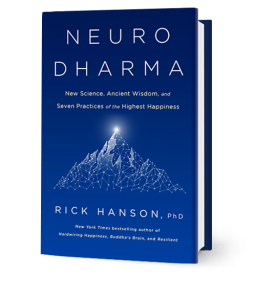
Neurodharma by Rick Hanson, Ph.D.[/vc_column_text][vc_separator type=”normal”][vc_column_text]Mind in Life – excerpt from Neurodharma[/vc_column_text][vc_separator type=”normal”][vc_column_text]
The Self is a Unicorn – excerpt from Neurodharma
[/vc_column_text][vc_separator type=”normal”][vc_column_text]
Meditation + Talk: Changing Your Mind
[/vc_column_text][vc_separator type=”normal”][vc_column_text]Mind Changing Brain Changing Mind[/vc_column_text][vc_separator type=”normal”][vc_column_text]
Stress: Understanding the Mind-Body Connection
[/vc_column_text][vc_separator type=”normal”][vc_column_text]
Being Well Podcast: Self-Transcendent Experiences
[/vc_column_text][vc_separator type=”normal”][vc_column_text]
Grounding the Mind in Living Body
[/vc_column_text][vc_separator type=”normal”][vc_column_text]
[/vc_column_text][vc_separator type=”normal”][vc_column_text]
[/vc_column_text][vc_separator type=”normal”][vc_column_text]
[/vc_column_text][vc_separator type=”normal”][vc_column_text]
The Neurology of Awareness and Self
[/vc_column_text][vc_separator type=”normal”][vc_column_text]
Is the Mind-Body Problem a Problem at All?
[/vc_column_text][/vc_column][/vc_row]