


Meditation
[vc_row css_animation=”” row_type=”row” use_row_as_full_screen_section=”no” type=”full_width” angled_section=”no” text_align=”left” background_image_as_pattern=”without_pattern”][vc_column][vc_column_text]<– Return[/vc_column_text][/vc_column][/vc_row][vc_row css_animation=”” row_type=”row” use_row_as_full_screen_section=”no” type=”full_width” angled_section=”no” text_align=”left” background_image_as_pattern=”without_pattern”][vc_column width=”2/3″]
What the definition of Vipassana meditation?
Vipassana is aided by shamatha, the development of steadiness of mind, including through Right Concentration and the jhanas. The two support each other.
There is more there about all this in the Steadying the Mind chapter of Neurodharma?[/vc_column_text]
I am struggling with a deep inner flaw or behavior that stops me from really being able to meditate or even make a change in my life. How do I wash my hands clean of the blood?
[/vc_column_text]
If meditation practice benefits our lives, but we get wonky feelings while meditating: 1) What kind of sensations are to be expected and how do we recognize that they are safe? As you know, there is also research data of adverse effects of meditation. 2) If those sensations are normal, how should we work with the feelings that arise from them?
[/vc_column_text]
When, in our practice, we lose a sense of having boundaries around our individual body, how might this be different from dissociation? Are there clear experiential differences, and/or measurable differences in brain activity between the two?
In clinical psychology, “dissociation” generally means a state of consciousness that may be adaptive during specific traumatic events or to get through a very difficult time (e.g., childhood with an abusive mother), but otherwise is problematic in the ways that it is numbing, with decreased executive function and coping, with less mindful presence, and with little or no sense of emotionally positive well-being.
In meditation, and in practice altogether, we can have a growing sense of, say, “a softening of edges, opening into everything, knowing you are lived by everything” while also having a sense of well-being, a continuity of mindful presence, and a sustained capacity to respond skillfully to events as needed. This is not dissociation in the clinical sense.
I’ve written about ways that someone who is vulnerable to dissociation can remain grounded and present even as they move into the deeper waters of meditation. For example: staying aware of the internal sensations of breathing, while from to time touching into the sense of being alright right now and with a warm heart. And if one likes, moving a little or even doing walking meditation.[/vc_column_text]
Your work is based on the idea that meditation and mindfulness can change the brain. Can you expand on this?
For example, researchers studied cab drivers who must memorize London’s spaghetti snarl of streets, and at the end of their training their hippocampus – a part of the brain that makes visual-spatial memories – had become thicker: much like exercise, they worked a particular “muscle” in their brain, which built new connections among its neurons. Similarly, another study found that long-term mindfulness meditators had thicker cortex in parts of the brain that control attention and are able to tune into one’s body.
In the saying from the work of the Canadian psychologist, Donald Hebb: “neurons that fire together, wire together.” Fleeting thoughts and feelings leave lasting traces in neural structure. Whatever we stimulate in the brain tends to grow stronger over time.
A traditional saying is that the mind takes the shape it rests upon. The modern update would be that the brain takes its shape from whatever the mind rests upon – for better or worse. The brain is continually changing its structure. The only questions are: Who is doing the changing: oneself or other forces? And are these changes for the better?
In this larger context, my focus is on how to apply these new scientific findings: how to use the mind to change the brain to change the mind for the better – for psychological healing, personal growth, and (if it’s of interest) deepening spiritual practice. I’m especially interested in:
- How the brain has been shaped by evolution, giving us problematic tendencies toward greed, hatred, heartache, and delusion (using traditional terms) as well as wonderful capacities for happiness, peace, love, and wisdom. For example, we have a brain that makes us very vulnerable to feeling anxious, helpless, possessive, fixated on short-term rewards, angry, and aggressive. These qualities helped our ancestors survive and pass on their genes, but today they lead to much unnecessary suffering and conflict on both personal and global scales.
- “Neurologizing”, the deep Buddhist analysis of the mind: what is going on inside the brain when a person is caught in the craving that leads to suffering? Alternately, what is happening in the brain when a person is experiencing equanimity, lovingkindness, meditative absorption, or liberating insight?
- Using neurologically-informed methods to help overcome our ancient inclinations to fear, dehumanize, exploit, and attack “them” so that 7 billion of us can live in peace with each other on our fragile planet.
In sum, this brain stuff can sound exotic or esoteric, but in essence the approach is simple: find the neural processes that underlie negative mental factors, and reduce them; meanwhile, find the neural processes that underlie positive mental factors, and increase them. Less bad and more good – based on neuroscience and Western psychology, and informed by contemplative wisdom.
Of course, much is not yet known about the brain, so this approach is necessarily an exploration. But if we remain modest about what we don’t know, there are still many plausible connections between the mind and the brain, and many opportunities for skillful intervention for ourselves, for our children and others we care for, and for humankind as a whole.[/vc_column_text]
Is there a recording available of a guided meditation for your HEAL framework?
- Noticing and Creating Beneficial Experiences
- Enriching and Absorbing Being Loving
- Taking in Key Resource Experiences
- Practice of Linking
Also, I have extended guided practices in the audio version of my book, Hardwiring Happiness, that you might like (chapter 10 is pretty much three chapters worth of guided practices).[/vc_column_text]
How do you teach mindfulness for the first time to a general audience of adults?
Next I introduce the idea of sustained present moment awareness – the definition of mindfulness – as both an excellent training in attention regulation and an excellent practice in its own right.
Then we begin the practice, first seeing if they can sustain attention to the sensations of breathing – around the nose, or in the chest or belly, or in the body in general – for say 10 breaths in a row. (I always also state that other objects of attention are fine, such as a word like “peace.”) I could make a few comments about steadiness of mind, and remaining attentive to their own attention: meta-cognitive awareness of awareness. I might also gently suggest finding a posture that is comfortable and alert.
On the basis of the steadiness of mind established in this way, at some point – a few minutes in – I suggest that they remain aware of their object of attention while also staying present in this moment, and this one. Not resisting the thoughts and feelings and sounds etc. that come and go, just disengaging from them. Simply be-ing, gently relaxing, opening, softening . . . without strain or stress, opening into a growing well-being and peace . . . a kind of space or underlying quality of being that contains any pain or upset.
Usually we stay pretty quiet, though sometimes with a comment here or there by me to help draw people back into the practice.
And then we finish up. Gradually drawing people back into the room, opening their eyes if they’ve closed. Registering what the experience is like, and letting it sink in.[/vc_column_text]
What would you suggest to help someone persist in practicing HEAL?
- It’s usually quick and in the flow of everyday life, a dozen seconds here and half a minute there, a few times a day, helping good learning land and stick to your ribs.
- It’s usually enjoyable, since – remarkably – most psychologically beneficial experiences are enjoyable. We have evolved rewarding associations to them because they actually help us survive to pass on our genes, in addition to all the benefits in terms of quality of life. These experiences feel good because they are good for us and others.
- HEAL makes real changes in your brain, which is motivating to know.
So I find that using HEAL becomes pretty natural for people, like any good habit. If you’re a mental health professional you can do things with clients to encourage them to focus on key resource experiences between sessions, or simply put little reminders around them like doing HEAL at specific times such as at meals or just before bed or just after exercising or meditating.
As to regular mindfulness practice, you can use HEAL to internalize the experience of mindfulness so it comes more easily and you get better at it – just like internalizing the experience of any other inner strength, to grow it inside yourself. Similarly, you can use HEAL to internalize the benefits of mindfulness – or related practices such as meditation – so you get more motivated to practice as you experience its rewards.
Also, try making a commitment to meditate – which could include for a person the theistic version of contemplative practice, which is prayer – at least one minute a day.[/vc_column_text]
If someone was to adopt just one daily practice to foster a Buddha brain, which would you recommend?
How do we know that our daily practice is 'working' and how does one measure such a thing?
I think there are two key parts to practice:
- Disentangling from the conventional suffering-saturated strategy for happiness, which is ultimately doomed.
- Opening into that which is a reliable basis for lasting true happiness.
I have been served by various Tibetan sayings:
- In the beginning nothing came; in the middle nothing stayed; in the end nothing left.
- In the beginning nothing came; in the middle nothing stayed; in the end nothing left.
- Gradual cultivation, sudden awakening.
- Moments of awakening, many times a day
- If you take care of the minutes, the years will take care of themselves.
I also try to operationalize “working.” Is the heart becoming more open, are we increasingly able to “cling to nothing in this or any world,” are we becoming more accessible to unconditionality, are we becoming more contented, loving and peaceful?[/vc_column_text]
Is gratitude beneficial as a spiritual and/or mindfulness practice in and of itself?
Of course, each of these benefits also gently and gradually shapes one’s own brain in an increasingly positive direction.[/vc_column_text]
What methods can you recommend to help boost memory?
Doing mental activities that work the memory “muscles” could help. Like playing bridge and having to remember key cards, learning a new language, or taking a class that calls for considerable memorization.
And if you’re not doing meditation routinely, I suggest it, too. Among its benefits are strengthening executive oversight of mental processes, which aids memory plus provides more influence over one’s thinking.[/vc_column_text]
Can MBSR really be labeled as mindfulness meditation if it only relies on the sustained present moment awareness and not without the old theories of awareness?
When taken by itself, there is considerable research evidence for the benefits of MBSR in particular and of related secular trainings in mindfulness (defined as sustained present moment awareness, typically combined with qualities of self-acceptance and curiosity). This research is credible and a sound basis for applications in the settings you work in. So, from a secular perspective, things seem clear. MBSR is not Buddhist any more than self-awareness, attention training, self-acceptance, or meta-cognition are Buddhist. If someone says, “We can’t teach mindfulness since that is Buddhist,” I politely tell them that this is mistaken: the Buddha in particular and Buddhism in general has no monopoly on mindfulness, compassion, taking personal responsibility, insight, or kindness even though these are central elements of Buddhism.
But, from a Buddhist perspective, some people (such as Jon Kabat-Zinn and other respected teachers) think it is fine to extract elements of Buddhist practice (e.g., mindfulness) and then apply them outside of that Buddhist context, while other respected teachers think that this is wrong to do. Myself, I side with Jon on this question.[/vc_column_text]
Is bad science driving the popularity of mindfulness meditation?
The evidence for most healthcare interventions, including routine medical practices, is nonexistent, limited, shows mild benefits at most, or could be questioned methodologically. In this context, check out these two links:
- //media.rickhanson.net/home/files/SlidesIntegrativePsychiatrySept2011.pdf
- https://rickhanson.net/files/slides/IntegrativePsychiatrySept2011_PapersCited.pdf
As you can see in these links, the evidence for mindfulness and related practices (e.g., meditation) for promoting mental and physical health is quite robust. If Pfizer or Merck could patent meditation, based on the research findings already, we’d regularly be seeing ads for it on primetime TV.
There is a kind of pocket industry of debunkers who make their bones trying to taking down interventions that have any kind of holistic, new age, or spiritual air about them. It is so easy to debunk things. You can debunk nearly anything. You can always find fault with academic papers. You can always call for more evidence. So let’s call for more evidence in domains with big risks instead of tiny ones.
Meditation is free or inexpensive, has rare (but occasional, as Willoughby Britton’s research has found for some vulnerable people going into intensive meditation retreats) negative side effects, and can be done in many kinds of settings by many kinds of people in many kinds of ways. Its benefits, and the evidence for its benefits, should be netted against its very low risks; the higher the risks, the higher the need for evidence for an intervention, but the lower the risks, the lower the need for evidence for an intervention. About 200,000 people die each year in America due to medical error. If you participate in medicine, there are significant risks, I don’t say this to criticize medicine – I value it highly and am grateful to my doctors – but to put this issue in context. How many people die each year due to participating in meditation? The risks are tiny.
Sure, we should be careful about over-claiming about the evidence for anything. But I rarely see that. Mostly I see people saying essentially that meditation could help you become more self-aware, lower your stress, and grow calm and other resources inside yourself, and these psychological developments couldn’t hurt your health and might even help it through the stress reduction pathway. You know, this statement is accurate when applied to the majority of people who take up meditation.[/vc_column_text]
Can you suggest something to help me breathe mindfully?
No worries, actually: in meditation, the point is not the object/anchor of attention, the point is the quality of sustained presence of mind moment after moment – along with related helpful factors such as self-compassion, acceptance, and learning along the way from one’s experiences. So you could shift to any number of other, often common, objects of attention, such as a word or phrase (e.g., “peace,” “may we be happy,” “om”), an image (e.g., a candle, a picture of a saint, a memory of a beautiful meadow), or sensations in other parts of the body. And you could also do meditation while walking slowly.
If you still want to explore breathing, what I do is have a general awareness of my torso and whole body while breathing rather than focusing on any particular spot, and without trying to regulate breathing in any way. Move out to the body as a whole, and let the sensations of breathing come to you as it were, receiving them without effort.
Meanwhile, there is a natural relaxation, letting go, warm-heartedness, and growing sense of well-being, contentment, and peace.[/vc_column_text]
What is the best time of the day to meditate?
From the standpoint of a long-time meditator, plus someone who teaches meditation, my practical answer is this: the best time to meditate . . . is whatever time you will actually do it. It’s a variation on the old line that the best exercise in the world for you is whatever you will actually do.
This said, there is science that the mind is quieter for most people when we first awaken in the morning, plus we are less likely to fall back asleep, so that is an easier time to meditate. Additionally, meditating in the morning lays a good foundation for your outlook and mood for the whole day. (And as a practical matter, if you meditate before the kids get up, if you have any, the house is still quiet.)
Science also shows that just before sleep, the mind and brain are very receptive. In this hypnagogic state, the influence of meditation is going to be high, with results that could ripple through the night. The tradeoff is that we are less alert since we are sleepy.
So perhaps the perfect combination is have your main meditation in the morning (however long it is, even just a few minutes), with a minute or more just before sleep.
But remember, no matter what the scientists say, the best time to meditate is the time that works best for you.[/vc_column_text]
How then do I reap the brain benefits of single-minded focus for five minutes?
Then, after the mental factor has been activated, we can either make it the object of focused attention or shift to the breath (or something else, such as a saying like “may beings be at peace”). If you are working on steadying the mind, a good focus especially in the beginning and intermediate stages of meditating, then you would probably give yourself over to the sensations of breathing, abiding as a body breathing, with from time to time a passing but beautiful sense of relaxing, the mind quieting, peace growing, opening, being here, being now. Pretty sweet![/vc_column_text]
What can I do if I get flooded with thoughts or painful feelings, even traumatic ones, when I try to meditate?
A quick suggestion would be to find something that is reliably comfortable and peaceful in your experience – such as the breath, or an object of beauty, or a saying – and use that as your meditation anchor. Maybe while standing or walking, to reduce the dissociation. And keep disengaging from painful thoughts; don’t fight them, ignore them. And from time to time look at them categorically; in other words, see their nature, the nature of all experience, all phenomenology: transient, made of parts, arising and passing away due to causes, insubstantial, an unreliable basis for lasting happiness; seeing them in this way, they have less weight.[/vc_column_text]
Do you think playing computer solitaire fulfills the goal of mindfulness and meditation?
Sure, the “circle” of mental activities – and thus the neural processes and gradually building of neural structure – of meditation overlaps the “circle” of these while playing solitaire on the computer (or playing other games in other ways), but there is a lot about each circle that is distinct from the other one.
Game playing will strengthen intellectual and other cognitive capacities (e.g., visual processing, perceptual analysis) that meditation will not.
On the other hand, meditation will building other capacities, such as strengthening attention (because of the relatively non-stimulating nature of breath sensations or other common targets of contemplative attention), the capacity to disengage from mental processes to observe them peacefully rather than getting swept away in chasing mental carrots or dodging mental sticks, and insight into both personal psychological material (e.g., the hurt lingering underneath resentments) and the general nature of mental phenomena as transient and usually not worth getting one’s knickers in a twist about. Plus meditation confers many other benefits, including stress reduction, managing anxiety, and reducing the distress and sometimes symptom intensity of many medical conditions. (Check out this slide set from a workshop I gave to psychiatrists for more on this.)
While intellectually stimulating activities such as game playing have been shown to help protect against cognitive decline with aging, preliminary studies have also shown that religious and spiritual activities (which include prayer and meditation – though a person can meditate outside a religious frame and still get most if not all of its mental and thus neural benefits) also offer protections against cognitive decline, here too through overlapping “circles” of factors.
Bottom-line: I say do both! Have fun with solitaire, and find some contemplative practice that suits you. If you like, commit to meditating at least one minute a day, even if it’s the last minute before you fall asleep. And like many things, there is a dosing effect: the more meditation you do, the better for your brain.[/vc_column_text]
Can you help clarify how to work with negative thoughts in meditation?
- Open awareness (sometimes called vipassana though that’s a misnomer since vipassana means insight which can be present during many modes of meditation and daily life, and insight can be absent during open awareness) – Allow negative thoughts to come and go, observe them without reaction, ground more and more deeply in relaxed awareness/beingness/well-being.
- Focused attention – Pull attention firmly away from anything other than the object of concentration/absorption (e.g., the breath). Negative thoughts may persist but dimly outside the field of concentrated absorption.
The batting away strategy is a detail for the focused attention approach. Sometimes when the mind is quiet we can see distracting thoughts starting to arise and congeal, and we can gently bat them away before they fully “invade the mind and remain” (as said by the Buddha).
It is also possible in meditation, in an open awareness frame, to use the meditative state to investigate negative thoughts to sense down into deeper, warmer, more emotional layers, as you say. The art in doing this is to avoid therapizing oneself and getting all caught up in self-analysis, but also try to get to the bottom of things. Check out the RAIN Method that Tara Brach, James Baraz, and others talk about.
If negative thoughts are overwhelming if you let them in, perhaps best in meditation to focus on concentration methods, and outside meditation engage practices like RAIN.[/vc_column_text]
How is paying attention to exhaling distinct from extending the exhalation?
As to whether the increase of awareness of exhalation distinct from that awareness tending to slow the breath is an open question. I’ve never seen a study on this, but there is a lot that is not yet studied that is still true or useful! It is plausible to me, though without any evidence I know, that increasing attention to exhaling in and of itself would tend to increase parasympathetic tone since neural networks tend to increase their activation when we pay attention to them, including sensory networks, and those increases in activation also tend to ripple through related networks, such as the PNS.[/vc_column_text]
Does meditation utilize the social circuitry of the brain?
I would like to have your perspective on some recent studies on the negative effects of mindfulness meditation.
As far as I know, these are the basic cautions. They apply to a tiny fraction of the people who meditate, and a tiny fraction of the settings in which they meditate. If someone is in that tiny fraction of people, be very cautious about prolonged and intensive retreats – and be careful about meditating on your own at home.
As best I can tell, the rest is media drama – essentially saying, by analogy, people with vulnerable legs shouldn’t run marathons. Wow, breaking news.
Just observe your own experience. If your way of meditating is working for you, great. If not, modify it or stop it. Use common sense.[/vc_column_text]
I've experienced emotional abuse, a serious brain injury, PTSD, anxiety, and depression - and I find it hard to meditate. Any suggestions?
- Neurofeedback
- Sensorimotor training (e.g., Baniel Method, Feldenkrais)
- Functional medicine type assessment of your overall physiology, and then systematically optimizing it as best you can
- Using an emotionally positive and stimulating object of attention for meditation – such as love for others, contentment, gratitude, bliss after pranayama – and marinating in happiness, both to help steady the mind and to potentially help tip your brain more toward positivity
And of course, keep knowing and feeling your own obvious goodness.[/vc_column_text]
I teach a beginner's meditation course at the county jail. A woman in the jail approached me last night and asked for any suggestions on what might help with a severe head injury? Any suggestions?
- Go after functional issues in their own right, which may or may not have a neurological basis. Such as mood, regulation of attention, impulse control, internal sense of integrated wholeness, etc.
- Avoid toxins (e.g., alcohol, pesticides) since she has a vulnerable brain.
- Avoid inflammation, not good for the brain (e.g., foods she is allergic to – gluten and dairy are common culprits – or living in a mold smelling basement)
- Minimize stress, including from irritation, worry, hurt (yah, I know easier said than done), since chronic cortisol is bad for the brain.
- When she gets out of jail, take a regular good fish oil supplement (or flax oil if she is a super vegetarian) since “essential fatty acids” in fish oil are so important for brain health.
- If she can afford it, try “sensorimotor integration,” Feldenkrais, or Baniel-method type work with a relevant professional to build up her integrative capacities, which might be helpful for language and for linking left and right hemisphere functions. Sometimes this type of intervention is extremely helpful, and sometimes it makes no big difference; hard to tell until one tries it.
- Also try neurofeedback, with an experienced, sensible, not promising the moon kind of professional.
- Also look into Lumosity or similar online programs or apps. Find ones that speak to her issues, play with them, and see whether they help.
- Marinate in positive emotions as much as possible, especially the ones that are good “antidotes” (see the Learning pillar in FWB) for her particular issues, such as feeling alright right now antidoting anxiety, or feeling cared about antidoting being let down by others in her past. Besides being potentially rehabiliative neurologically, this is worth doing in its own right.
- As best she can, find meaning and joy and service and purpose in this life as it is.
[/vc_column_text]
Is it better to meditate in short but frequent sessions or one longer one?
My own experience is that in a longer sit there is often sort of a trajectory of value (as I define value, such as steadying and quieting of the mind, opening into deep peacefulness, insight) that goes like this (estimated times are very loose):
- Settling in, mind wandering some (~ 5 minutes)
- Stability of presence, calming, centering (10-20 minutes)
- Spinning out into thinking about some topic (problem to solve, ruminating about politics, whatever) (10 minutes)
- Regathering of resolve to meditate, sliding into deep centeredness (15 minutes)
- Finish
So if I did not keep sitting, I would not experience that last powerful phase.
On the other hand, I can see the value – per your analogy to learning theory – of several brief sits a day. But then there might be practical issues. If a person thinks, OK, I’ll meditate for a total of 30 minutes a day . . . how is the person more likely to get that 30 minutes? In one long sit, or in (say) three sits of 10 minutes each? Will the person actually do those three separate sits each day??
Bottom line, whatever is most helpful and motivating, that’s what one should do. The most important meditation is the one that you will actually do![/vc_column_text]
Can you recommend any work on the neuropsychological or neurophysiological aspect of meditation?
- Stress reduction correlates with structural changes in the amygdala
- Brain Structure and Meditation: How Spiritual Practice Shapes the Brain
- How Does Mindfulness Meditation Work? Proposing Mechanisms of Action From a Conceptual and Neural Perspective
- Is Self Special? A Critical Review of Evidence From Experimental Psychology and Cognitive Neuroscience
- Meditation experience is associated with increased cortical thickness
- Meditation States and Traits: EEG, ERP, and Neuroimaging Studies
- Radical embodiment: neural dynamics and consciousness
- Relationships between meditation depth, absorption, meditation practice, and mindfulness: a latent variable approach
I’ve also found the work of Judson Brewer, Britta Holzel, and of course Richie Davidson to be solid sources, as well as the book Altered Traits by Davidson and Daniel Goleman.[/vc_column_text]
I would appreciate any resources for help with balancing awareness of the tinnitus sound with other awareness during mindfulness meditation.
In particular, it might be beneficial to focus on the sense of the whole body, the body as a whole, abiding as a whole body breathing.
You might also check out my article, Blocks to Inner Practice, which offers some ideas for how to work with any blocks that might come up in meditation, yoga, gratitude and mindfulness practices.[/vc_column_text]
Will you offer a few other suggestions for implementing your practices through the holidays and the New Year?
- Notice that you truly are basically alright right now several times a day, which would help undo the anxious background murmur we inherited through evolution.
- Really enjoy your hands, drawing you into more intimate and sensual contact with things around you.
- “Fill the hole in your heart” by sensing that key positive experiences are sinking down into you and touching places of old lack or pain. For example, since I was a shy and nerdy kid who felt lonely and unwanted, I’ll deliberately sense that experiences these days of feeling included and valued are soothing and feeding the younger layers of my mind. Neurologically, this gradually infuses resources into old wounds, helping to heal them in the process.
- Take refuge a few times each day in one or more things that are sources of strength, refueling, or inspiration for you. Simply say to yourself, “I take refuge in _______ ,” or just get a feeling of being connected with this refuge, as if it you are already in it.
Whatever your practice is, take a moment to recognize its value for you. Keep bringing it to mind, at least once or twice a day. If you take care of your practice, it will take care of you.[/vc_column_text]
How can meditation be used as a tool when people are suffering from basic survival issues?
People can also use related practices such as meditation as way to avoid dealing with real issues of all kinds.
This said, mindfulness practices can help people develop the inner stability that fosters greater resilience for dealing with whatever they’re facing. And as one’s personal well-being improves at least a little, sometimes their view can widen and see more clearly the problems around them, and feel more resourced inside to be helpful to others.[/vc_column_text]

Additional Resources
Guided Meditation Practices An array of guided meditation practices from Dr. Rick Hanson
[/vc_column_text][vc_separator type=”normal”][vc_column_text]
Being Well Podcast: Meditation – Purposes, Methods, and Common Misconceptions
[/vc_column_text][vc_separator type=”normal”][vc_single_image image=”42468″ img_size=”full” onclick=”custom_link” img_link_target=”_blank” qode_css_animation=”” link=”https://rickhanson.net/teaching/wednesday-meditations-with-dr-rick-hanson/”][vc_separator type=”normal”][vc_column_text]
Meditation + Talk: Why and How to Meditate
[/vc_column_text][vc_separator type=”normal”][vc_column_text]
Meditation + Talk: Why and How to Meditate – and Answering Questions
[/vc_column_text][vc_separator type=”normal”][vc_column_text]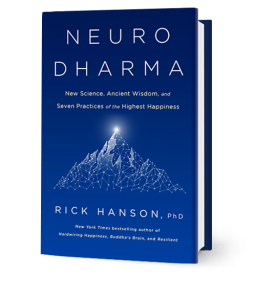
Neurodharma by Rick Hanson, Ph.D.[/vc_column_text][vc_separator type=”normal”][vc_column_text]
[/vc_column_text][vc_separator type=”normal”][vc_column_text]
[/vc_column_text][vc_separator type=”normal”][vc_column_text]
[/vc_column_text][vc_separator type=”normal”][vc_column_text]
Meditations to Change Your Brain
[/vc_column_text][vc_separator type=”normal”][vc_column_text]
Types of Meditation talk
[/vc_column_text][/vc_column][/vc_row]