Reviews

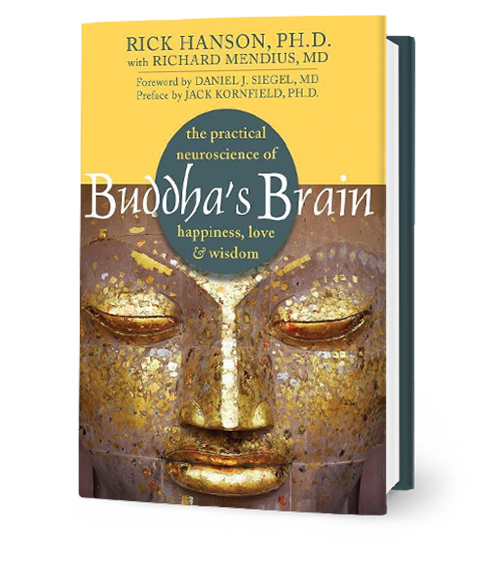
Buddha's Brain Cover[click image to order]
Inquiring Mind (Spring 2010)
If you are intrigued by the latest findings in neuroscience and wondering what they suggest for your spiritual life or mediation practice, then this is the book for you. Buddha’s Brain is a clear, accessible explanation of how our brain and nervous system interface with our experience of life and how the path of Buddhadharma can effect a change for the better. The book not only makes this complex subject understandable, but it offers the reader mindfulness0based exercises that turn the latest scientific discoveries into skillful means. As Rick Hanson writes, “You can do small things inside your mind that will lead to big changes in your brain and your experience of living. . . When you change your brain, you change your life.” We all have Buddha’s brain, and this book is a manual to awaken it. 
 Wes Nisker

Eden Prairie News (7/28/10) Summer has brought a more relaxed pace in our household what with the demands of homework and school activities gone – and it feels wonderful. I’ve actually been able to carve myself a cherished morning time for spiritual reflection while the kids sleep in.

Reading Buddha’s Brain: The Practical Neuroscience of Happiness, Love and Wisdom has filled some of that time and been a very gentle, informative reminder of how important it is to make time to nourish one’s brain, mind and spirit.

The authors, Rick Hanson (neuropsychologist) and Rick Mendius (neurologist), are both Buddhists, but speak to the importance of “contemplative traditions” among all faiths. A major premise of their book is that the human brain has evolved to be much more adept at scanning for and focusing on negative or threatening circumstances, primarily as part of our critical fight-or-flight response that helps keep us out of harm’s way and maximize our survival.

While they acknowledge the value of this ability to shift rapidly into such a hyper-aware state, the book focuses more on the importance of cultivating greater mindfulness of the good and beauty in our lives. And not just for the purpose of creating a positive state of mind, but beyond that, of actually restructuring our brain. They note, “What flows through your mind sculpts your brain.”

Evidence is cited of how neurotransmitters are released in response to different stimuli, such as dopamine when one mindfully focuses on how comforting a particular hug feels. Information is also offered on how nutrition and nutritional supplements can enhance brain health. Research is presented which confirms via MRI’s that certain areas of the brain become strengthened through development of stronger connections as a result of frequent use of that part of the brain. An example given of this is the more developed left frontal lobe of those who regularly meditate.

Through the evidence, it becomes apparent that every thought we think, every emotion we feel, releases chemicals within our system which travel between neurons, strengthening existing neural pathways and forging new ones as necessary. It truly is empowering to think that we have the ability to restructure our brain and that, in turn, we can influence how incoming stimuli are received and processed.
We are left with a stronger sense of how important prayer, meditation, faith, greater mindfulness and positive thoughts are. These are not just words or thoughts that go nowhere. We see their power, their energy, their connection to the life force of our universe. We come to more fully understand their power as they manifest through and out of us and emerge as new consciousness, new behaviors, a new way of being.

Similarly, we become more conscious of what thoughts and images we are taking in via our surroundings, be it friends, media, the beauty we surround ourselves with, the reflective time we make for ourselves, etc. Our entire being is impacted, physically and spiritually. The authors speculated, “In fact, the relaxation response may actually alter how your genes are expressed, and thus reduce the cellular damage of chronic stress.” —Lauren Carlson-Vohs

Journal Sentinel (7/3/10) . . . To really know your brain is to appreciate the power you have to be happier, more content and at peace with yourself and the world. And who can’t use more inner peace? . . . A primer to fix our stress isn’t available. But it’s been proven (through MRI brain scans) that we can be more content, happier and at peace if we dig deep within ourselves to practice strengthening our brains . . . Neuropsychologist Rick Hanson has published a how-to manual, “Buddha’s Brain: The Practical Neuroscience of Happiness, Love & Wisdom” . . . This handbook is based on hard science and easy-to-understand contemplative practices such as meditation, deep breathing and “taking in the good.” . . . Perhaps never before has the interface between hardcore brain science and ancient musings been connected with such enthusiasm . . . Physician-author Daniel Siegel writes in his introduction: “A revolution in science has recently revealed that the adult brain remains open to change throughout the lifespan . . .  we come to realize that we can actually use the mind to change the brain.” . . . And now finally, the handbook, based on the latest neuroscience, with user-friendly steps for anyone who wants to create positive change internally .  . . —Polly Drew

Library Journal (9/18/09) Hanson and Mendius successfully answer the question: How can you use your mind to strengthen positive brain states and ultimately change your life? Arguing that our ancestors’ brains, flooded with adrenaline and cortisol, were wired for survival, the authors reveal how this neurological propensity for high arousal contributes to our present-day chronic illness, depression, and anxiety. Using Buddhism’s eightfold path as a model, they illustrate how meditation and relaxation can change our brain’s natural tendencies. Pictures illustrate the brain’s functions and practical meditation exercises are found throughout. The authors also discuss the importance of diet and nutritional supplements. Verdict: An excellent choice for readers wishing to take control of their lives and spiritual well-being. Readers will find practical suggestions along with impressive research about the brain. —Phyllis Goodman, West Chester Lib., OH

Publisher’s Weekly (9/14/09) The brain physiology associated with spiritual states has been fertile ground for researchers and writers alike. Neuropsychologist and meditation teacher Hanson suggests that an understanding of the brain in conjunction with 2,500-year-old Buddhist teachings can help readers achieve more happiness. He explains how the brain evolved to keep humans safe from external threats; the resulting “built-in negativity bias” creates suffering in modern individuals. Citing psychologist Donald Hebb’s conclusion that “when neurons fire together, they wire together,” Hanson argues that the brain’s functioning can be affected by simple practices and meditation to foster well-being. Classic Buddhist concepts such as the “three trainings”—mindfulness, virtuous action and wisdom—frame Hanson’s approach. Written with neurologist Mendius, the book includes descriptions and diagrams of brain functioning. Clear instructions guide the reader toward more positive thoughts and feelings. While the author doesn’t always succeed at clarifying complex physiology, this gently encouraging “practical guide to your brain” offers helpful information supported by research as well as steps to change instinctive patterns through the Buddhist path.

Consumer Reports on Health – Those Late-Night Worries (2/10) I sometimes wake up in the middle of the night with my brain rattling with fears. Is that crick in my neck caused by a tumor? Are the kids OK? What will I write for this month’s editor’s note? The worries usually vanish in the morning light and I wonder why I wasted all those good sleeping hours. The new book, Buddha’s Brain, offers an interesting explanation by relating insights from brain research to techniques Buddhist monks use to manage the mind. When you’re awake but not involved in anything, your brain tracks the environment and your body for possible threats, write the authors, Rick Hanson, Ph.D., a neuropsychologist and meditation teacher, and Richard Mendius, M.D., a neurologist. That may have helped our ancestors by not letting them sleep too soundly in hostile environments. But it can take a toll on us when we’re safe in our bed. Research has found that the brain may be drawn to bad news and wired to ignore the good. That negative bias highlights past losses and failures, downplays current abilities, and exaggerates future obstacles. The solution? Learn to enjoy the positive, the authors suggest. Throughout the day, savor the good things that happen by focusing on the positive emotions and sensations for at least 5, 10, or 20 seconds. When random anxieties and negative thoughts arise, counter them by recalling good feelings. And that reminds me of advice my father used to give me: “It will all look better in the morning.” – Ronni Sandroff, Editor

Chicago Tribune - Things We Love: Self-Help for Smarties (2/14/10) Tired of flaky theories and dubious claims? We found the perfect antidote in Buddha’s Brain: The Practical Neuroscience of Happiness, Love and Wisdom by neuropsychologist Rick Hanson and neurologist Richard Mendius. This clear, compelling little gem of a book, currently getting significant buzz at Amazon.com, makes a powerful scientific case for the benefits of meditation and offers simple and highly effective exercises to get you started. — Nara Schoenberg

Inquiring Mind (Spring 2010) If you are intrigued by the latest findings in neuroscience and wondering what they suggest for your spiritual life or mediation practice, then this is the book for you. Buddha’s Brain is a clear, accessible explanation of how our brain and nervous system interface with our experience of life and how the path of Buddhadharma can effect a change for the better. The book not only makes this complex subject understandable, but it offers the reader mindfulness0based exercises that turn the latest scientific discoveries into skillful means. As Rick Hanson writes, “You can do small things inside your mind that will lead to big changes in your brain and your experience of living. . . When you change your brain, you change your life.” We all have Buddha’s brain, and this book is a manual to awaken it. 
—Wes Nisker

YogaBasics.com (12/20/09) . . . Hanson uses neuroanatomy, physiology and psychology to explain how the brain works in creating specific feelings and states of mind.  The bad news is that the brain and the body seem to be hardwired to create suffering.  The good news is that current research is showing that the brain is malleable and changeable, and it is changed by how we use it.   Likewise, the structure and biochemistry of the brain determines what types of thoughts and emotions can be created in our minds. Citing scientific research, Hanson shows how we can consciously work to re-wire our brains to produce peace, happiness, kindness and compassion through time tested . . . practices. This is a great book for anyone . . . who wants to understand what is physically and chemically happening in the brain during different states of meditation, thought, and emotion. —Timothy Burgin

zacharyburt.com (5/25/10) . . . my most recent read was Buddha’s Brain: The Practical Neuroscience of Happiness, Love & Wisdom by Rick Hanson and Richard Mendius. I really enjoyed it, and recommend it to anyone who wants a neuroscientific breakdown of important concepts in spirituality, Buddhism, meditation. . . Many helpful concepts are detailed alongside their neuroscientific mechanisms. You’ll get a great explanation of how the Prefrontal Cortex, Basal Ganglia, Anterior Cingulate Cortex, Hypothalamic-Pituitary-Adrenal Axis, and autonomic nervous system all operate in concert to create your experience of consciousness. If you enjoy the hand-wavey feel good books like Eckhart Tolle’s The Power of Now but get frustrated when grandiose claims of peacefulness are invoked without any material grounding, you’ll LOVE Buddha’s Brain. It explains the theory and then uses the theoretical framework to produce practical tips that anyone can use – even if you are a regular person living a hectic life and don’t have the luxury of a monastery. . . —Zachary Burt

Comments on this entry are closed.